
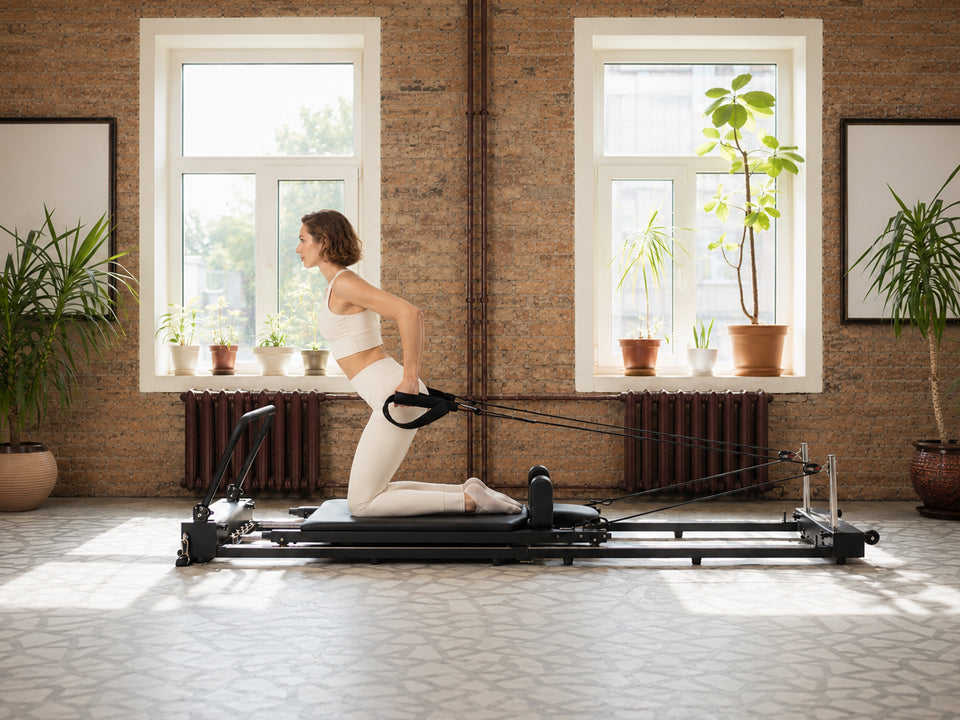
A reformer can make a light spring feel surprisingly serious. After a set of slow lunges, standing side splits, or long-stretch variations, your legs may shake in a way bodyweight exercise rarely achieves. So, can reformers build muscle? Yes, reformer training can support muscle growth and meaningful strength gains, especially when you use the springs with intention and continue challenging your body over time.
The more useful answer is that reformer Pilates builds strength differently than a traditional barbell-focused plan. It can improve muscular endurance, control, stability, and definition while creating enough resistance to support muscle development. How much visible muscle you build depends on your starting point, training volume, programming, nutrition, recovery, and whether your workouts continue to progress as you adapt.
For people creating a consistent home routine, that is good news. You do not need a crowded gym floor or an all-or-nothing training schedule to work toward a stronger body.
Can Reformers Build Muscle Through Pilates?
Muscle grows when it is regularly asked to handle more work than it is used to. This principle is called progressive overload. On a reformer, the resistance comes from springs, along with your body position, range of motion, tempo, exercise selection, and the challenge of keeping the carriage controlled.
A heavier spring is one way to increase the demand, but it is not the only way. Moving more slowly, working one side at a time, using a deeper range, holding a position longer, adding another set, or completing additional well-performed repetitions can all create a stronger training stimulus.
The reformer is particularly effective because it does not simply make an exercise harder. It gives you feedback. The moving carriage asks your core, hips, shoulders, and smaller stabilizing muscles to stay organized while larger muscle groups do the work. During a chest press, for example, you are not only pressing with your arms and chest. You are also controlling your ribcage, shoulder position, and carriage movement.
That combination can help beginners build noticeable strength relatively quickly. It can also give experienced exercisers a challenging, lower-impact way to train alongside running, lifting, or busy seasons of life.
What Kind of Muscle Can a Reformer Help Build?
Reformer training can strengthen the full body, but it tends to shine in areas that benefit from controlled resistance and alignment. Your glutes and legs work hard in footwork, bridges, lunges, and side-split variations. Your core is involved throughout nearly every carriage-based exercise, not just during traditional abdominal work.
Your upper body can be challenged with straps, long box work, planks, pulling exercises, and presses. Back and shoulder strength may also improve because reformer movements encourage you to move with control rather than rushing through momentum.
Many people first notice practical changes: stairs feel easier, posture feels more supported, and carrying groceries or lifting a child feels less taxing. Visible definition may follow, particularly in the arms, shoulders, legs, and glutes, but it is not a promise from any single workout method. Genetics, body composition, sleep, protein intake, and overall activity all influence what you see in the mirror.
If your goal is significant muscle size, a reformer can still be part of the plan, though it may work best alongside progressively heavier resistance training. If your goal is to feel stronger, more capable, mobile, and defined without relying on high-impact exercise, reformer Pilates may be enough to become your primary strength practice.
The Difference Between Feeling the Burn and Building Strength
A deep burn is common in Pilates, but burning muscles are not automatically a sign that you are building muscle. Often, that sensation reflects local muscular fatigue, especially during longer sets or slow pulses. It can be part of a productive session, but your progress should not depend on chasing it every time.
Instead, look for signs that the work is becoming more capable and controlled. You may move from a lighter to a heavier spring, complete more repetitions with steady form, or hold a plank with less shaking. You might be able to use a longer range in a lunge without losing balance or finish a full class without needing as many breaks.
Those changes matter. They show that your muscles and nervous system are adapting to the work.
The trade-off is that form remains essential. Adding spring tension before you can control the carriage may shift the exercise into your joints or lower back instead of the intended muscles. A challenging setup should feel demanding, not unstable or painful. If an exercise causes sharp pain, numbness, or joint discomfort, stop and choose a more appropriate resistance, range, or variation. Seek qualified professional guidance when needed.
How to Make Reformer Workouts More Muscle-Building
A thoughtful reformer routine does not need to be complicated. It needs enough resistance, consistency, training volume, and progression to keep your body adapting.
Start by choosing springs that make the final few repetitions challenging while allowing you to maintain a smooth carriage and steady alignment. The right spring load changes by exercise. You may use more resistance for footwork and bridges, then less for arm work or exercises that place you on one leg.
A reformer with several spring combinations makes that progression easier to personalize. The BeReform CORE Steel Foldable Reformer uses a five-spring system designed for approachable home training. The FLOW Wooden Foldable Reformer and PRIME Adjustable Wooden Reformer use six springs across different resistance levels, providing more combinations as your strength and exercise selection progress. More springs are not automatically better—the goal is to find enough resistance for the movement while staying in control.
Slow down the lowering portion of movements when appropriate. For example, resist the carriage as it returns during a row, press, or leg press rather than letting the springs pull you back. This controlled phase creates valuable time under tension and helps prevent your strongest muscles from taking over.
Train close enough to fatigue that the exercise feels challenging, but you do not need to reach complete muscle failure. Stop before your ability to move well breaks down. For many exercises, roughly 8 to 15 slow, focused repetitions can be a practical range, while some Pilates patterns work well at higher repetitions when the spring is lighter or the goal is endurance. There is no single repetition range that every movement must follow.
Finally, keep a simple record of your sessions. You do not need a complicated spreadsheet. Make a note when you increase spring tension, improve your range, add a repetition or set, or feel more stable in a movement. Small progress is still progress, and it is easier to recognize when you can see it.
A Weekly Routine That Supports Strength
For many people, two to four reformer sessions per week is a realistic place to start, depending on training experience, session intensity, and recovery. Consistency beats occasional marathon workouts, especially when you are fitting movement around work, family, and a home that needs to function as more than a gym.
Aim to include lower-body pushing work, hip extension for the glutes, pulling and pressing for the upper body, core control, and some mobility. A well-designed full-body class can cover these patterns without feeling like a long checklist.
Spacing challenging sessions across the week gives muscles time to recover. That recovery is part of getting stronger. On non-reformer days, a walk, gentle mat session, or mobility work can help you stay active without turning every day into a hard training day.
If you want to prioritize muscle size or maximum strength, consider adding one or two sessions with heavier tools, such as dumbbells or kettlebells, particularly for squats, hinges, presses, and pulls. This is not a requirement for better fitness. It is simply a useful option when your goal requires more load than your reformer exercises can comfortably provide.
Nutrition and Recovery Still Matter
Your reformer creates the training signal. Food and recovery help your body respond to it. Eating enough overall, getting protein regularly throughout the day, sleeping well, and allowing recovery between challenging sessions all support muscle repair and adaptation.
You do not need to turn eating into a complicated project. A practical starting point is to include a quality protein source at meals and snacks, drink enough water, and avoid treating hard workouts as a reason to underfuel. If you have a medical condition, injury history, or specific body-composition goal, individualized guidance from a qualified professional can be helpful.
Building Strength at Home Without Making It Harder Than It Needs to Be
The best strength routine is one you can return to. That is where a home reformer has a real advantage: your workout can happen before a meeting, after bedtime, or in the small window when you need to reset your energy. A foldable setup makes that consistency easier without asking your living space to look like a commercial gym.
BeReform reformers are designed for that everyday rhythm, with adjustable spring resistance and foldable designs made for repeat use at home. Still, the equipment is only one part of the equation. Your results come from showing up, choosing an appropriate challenge, gradually increasing the work, and giving your body time to recover.
Start with the springs and movements you can control today. A few focused sessions each week can become a strong, steady foundation for the way you want to move through the rest of your life.
Frequently Asked Questions
Can reformer Pilates build muscle without traditional weights?
Yes. Reformer springs create resistance that can improve strength, muscular endurance, and support muscle growth, particularly for beginners or people returning to exercise. For significant muscle size or maximum strength, progressively heavier dumbbell, kettlebell, or barbell training may still be useful.
How long does it take to build strength with a Pilates reformer?
The timeline varies with your starting point, workout frequency, exercise difficulty, recovery, and nutrition. You may notice better control and endurance before visible muscle definition. Instead of expecting a fixed deadline, track improvements in resistance, repetitions, range of motion, and stability over several weeks.
How often should I use a reformer to build muscle?
Two to four sessions per week can be a practical range for many people. Beginners may start with two or three full-body sessions and add frequency gradually. The sessions should be challenging enough to encourage adaptation while leaving enough recovery time between harder workouts.
Are heavier springs always better for building muscle?
No. Heavier springs can increase resistance, but they may also provide more support or make certain exercises difficult to control. Lighter springs can create a demanding stability challenge. Choose the setting that makes the target muscles work while allowing you to control the carriage and maintain alignment.
Which BeReform model is best for strength-focused home workouts?
The CORE offers a straightforward five-spring system for beginners and compact spaces. The FLOW provides a stable wooden frame and six-spring system for regular full-body training. The PRIME adds greater adjustability and is better suited to experienced users who want more flexibility as their training progresses.