
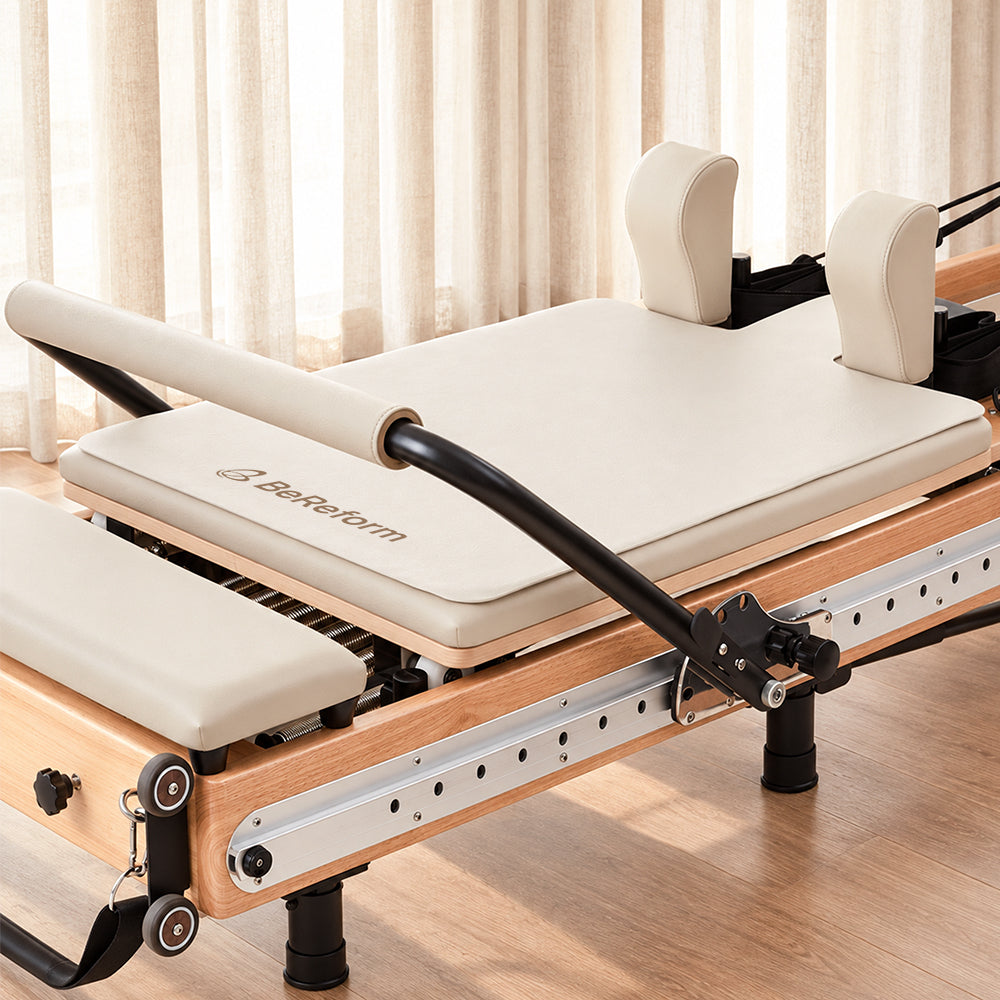
A reformer can look beautifully compact in a home gym and still feel frustratingly small once you lie down. Which reformer suits tall users? The answer is rarely just the longest model available. A comfortable fit comes from how the carriage travels, where the footbar adjusts, how stable the frame feels under load, and whether the machine gives your body room to move without constant compensation.
For someone over about 5'9", those details may become more noticeable. Long legs can run out of space in footwork, a longer torso may feel crowded during supine work, and a narrow or unstable platform can make simple transitions less relaxed. The right home reformer should let you focus on alignment and control, not on keeping your knees from meeting your chest sooner than intended.
Which Reformer Suits Tall Users at Home?
Tall users are usually best served by a full-length reformer with generous carriage travel, adjustable footbar positions, and a solid frame. A compact or folding reformer can still be an excellent choice, but folding capability alone does not tell you whether it will suit your height. The key is to compare the usable movement space, not simply the machine’s total length when it is set up or stored.
A longer frame often creates a more natural experience for exercises such as footwork, bridging, long stretch, and plank variations. Yet carriage travel matters just as much. If the carriage does not glide far enough away from the footbar, longer legs will reach their end range early. That can encourage bent knees, tucked hips, or shortened movement patterns that make a session feel less satisfying.
Height is also not one measurement. Two people who are both 6 feet tall may need different setups: one may have longer legs, while the other has a longer torso. Shoulder width, foot size, mobility, and preferred exercises can also influence comfort. That is why adjustability is more valuable than a one-size-fits-all claim.
Within BeReform’s range, the PRIME Adjustable Wooden Reformer offers the greatest adjustment range, including adjustable side rails and leg height. The FLOW Wooden Foldable Reformer provides a full-size wooden frame with fixed adjustments. Both are currently recommended for users up to approximately 6'5" or 195 cm, although individual proportions and movement preferences still matter.
Start With Your Movement, Not Your Height Alone
Before comparing reformers, think about where you tend to feel limited in exercise. If deep knee bends and leg extensions are your priority, footbar range and carriage travel deserve the most attention. If you enjoy strength-focused Pilates, planks, lunges, and standing work, frame stability and platform space may matter more.
For a studio regular moving workouts home, remember that familiar studio machines are usually built around a long, stable footprint. A home model does not have to be commercial-size to feel supportive, but it should offer enough range that your movement does not become smaller than your ability.
Beginners should not assume a shorter reformer is easier to manage. A properly fitted machine can make early sessions feel more approachable because you can find a comfortable pelvis position, extend your legs with control, and use the springs without awkward positioning. Comfort supports consistency, especially when you are building a routine between work, family, and everything else on the calendar.
Check Carriage Travel and Usable Bed Length
Carriage travel is the distance the moving platform can glide along the frame. For tall users, this is often one of the most practical specifications to ask about. A long-looking frame with limited carriage travel may not offer the extension you expect.
When reviewing dimensions, look beyond overall product length. Find out how much usable space is available on the carriage and whether the rail or stopper position can be adjusted. Consider the distance between the shoulder rests and footbar during typical footwork as well.
If a specification is unclear, ask the brand whether the reformer is recommended for your height and whether any components can be adjusted for longer legs or a longer torso. Providing your height and inseam can result in a more useful answer than height alone.
Your goal is not to force a completely straight knee in every exercise. Pilates movements are purposeful, and some call for soft knees or controlled bends. What you want is enough travel to extend comfortably through a normal range without shifting your pelvis, gripping through your hips, or feeling abruptly stopped by the carriage.
Overall length can also be misleading. For example, the BeReform CORE has a listed total length of 96 inches, while FLOW and PRIME are approximately 94 inches long. That does not automatically make CORE the better tall-user option. FLOW and PRIME have wider wooden frames, higher published weight capacities, and different carriage and adjustment systems. Dimensions need to be evaluated as a complete setup.
Look for a Footbar That Gives You Options
An adjustable footbar is especially helpful for different inseams and exercise variations. Multiple positions can bring the bar closer for bent-knee work or farther away for longer leg lines. It also makes the reformer more practical if more than one person will use it.
Pay attention to how the adjustment works. It should feel secure, straightforward, and easy to change without turning a home workout into a setup project. The best position is not necessarily the farthest one. It is the setting that lets you keep your pelvis steady and your feet supported while moving through a controlled range.
Footbar width and grip can matter, too. Taller users may appreciate room to place their feet in parallel, Pilates V, or a wider stance without feeling confined. A stable footbar gives you a stronger sense of support during leg work and plank-based exercises.
The shoulder rests and headrest also deserve attention. Your shoulders should settle comfortably without forcing your neck forward or leaving your upper body crowded. If the reformer will be shared, check how easily these components and the straps can be adjusted between users.
Frame Stability Matters More as Leverage Increases
Longer limbs create more leverage. That is not a problem, but it means an underbuilt or wobbly reformer can feel less secure during dynamic work. A sturdy frame, dependable carriage track, and well-designed base help the machine stay grounded when you press through your feet, move into a lunge, or shift from seated to standing positions.
Wood and steel can both provide excellent support when the construction is thoughtful. Rather than choosing solely by material, consider the overall build: how the carriage rolls, how firmly the legs sit on the floor, whether the platform feels planted, and how confidently the reformer handles regular use.
Weight capacity is not the same as height suitability, but it still matters. A reformer can be long enough for your legs while feeling too light or narrow for the way you move. Choose a model that supports your body weight with a comfortable margin and remains stable through the exercises you plan to perform.
Quiet movement is another practical benefit. A smooth carriage allows you to work with control in an apartment, upstairs room, or early-morning household without every repetition becoming a distraction. For a taller body, smooth tracking also helps you stay centered rather than subtly bracing against a rough or uneven glide.
A Folding Reformer Can Still Work Beautifully
Many tall users assume they must choose the biggest fixed reformer to feel comfortable. That is not always true. A well-proportioned folding reformer can provide a satisfying at-home experience while giving you back your floor space after class.
The trade-off is worth evaluating honestly. Foldable designs are ideal for shared rooms, apartments, and homes where a dedicated studio is not realistic. But before choosing one, confirm its open dimensions, carriage travel, recommended user height, weight capacity, adjustment options, and folding process. You should not have to compromise on a comfortable working length simply because you need storage flexibility.
BeReform FLOW and PRIME both use full-size wooden folding frames. FLOW uses manual folding, while PRIME adds hydraulic assistance, which can make frequent storage more manageable. PRIME also provides more adjustment options, making it the stronger choice for tall users who want to fine-tune their setup.
Also measure the room with the reformer open, not only when folded. Leave space at each end so you can step on and off comfortably, adjust springs, and move through exercises without brushing furniture. If you plan to use a box, jumpboard, or other accessories, account for those as well.
Use This Quick Fit Check Before You Buy
A tall-friendly reformer should pass a few real-life tests. Can you lie on the carriage with your head comfortably supported and your shoulders settled against the shoulder rests? Can you do basic footwork without feeling compressed at the top of the movement? Can you place your feet securely on the footbar in more than one position?
Then consider how the reformer will fit your household. If your partner is shorter, adjustable settings make it easier to share. If you need to store it after every workout, make sure the folding mechanism feels manageable for you, not merely possible.
Before buying, write down:
- Your height and inseam.
- Your body weight and the weight of the heaviest intended user.
- Your available workout and storage dimensions.
- The exercises you perform most often.
- The carriage, footbar, rail, rope, and stopper adjustments available.
- The manufacturer’s recommended user-height range.
If you are returning to Pilates after an injury or a long break, prioritize stable support and a calm, confidence-building setup over advanced features you may not use yet.
When a Larger Reformer Is the Better Investment
Choose a larger, more studio-inspired model when Pilates is likely to become a regular part of your week, you have sufficient floor space, or you consistently feel restricted on compact equipment. The extra room can make long-leg work, athletic sequences, and full-body strength sessions feel more natural. It may also be a better long-term choice for a household with multiple adults of different heights.
For tall BeReform shoppers, PRIME offers the most adaptable setup because of its adjustable side rails and adjustable leg height. FLOW may suit someone who wants the stability and width of a full-size wooden frame but does not need the same degree of adjustment. CORE prioritizes a lighter, narrower, space-saving design, so taller buyers should compare its usable carriage area, width, weight capacity, and fixed settings carefully before choosing it solely because of its overall length.
That said, bigger is not automatically better. An oversized machine that dominates your living space may be less likely to get used. For many homes, the sweet spot is a stable reformer with a comfortable carriage range that folds away neatly enough to keep the room feeling like yours.
BeReform’s home-focused approach is built around that balance: studio-inspired movement, practical storage, and several levels of adjustability for different spaces and users. The best choice is the one that fits your body and makes it easier to return to your practice tomorrow.
A reformer should give tall users more than a place to fit. It should give them room to lengthen, strengthen, and move with ease, right where life happens.
Frequently Asked Questions
What height is considered tall for a Pilates reformer?
There is no universal cutoff, but users around 5'9" and taller may begin to notice carriage travel, footbar position, and usable bed length more clearly. Body proportions matter as much as total height. A person with a long inseam may need a different setup from someone of the same height with a longer torso.
Is a 94-inch reformer long enough for a 6-foot user?
It often can be, but total frame length does not guarantee a good fit. Check carriage travel, shoulder-rest position, footbar adjustment, rope length, and the manufacturer’s height recommendation. BeReform currently recommends FLOW and PRIME for users up to approximately 6'5", but individual proportions and exercise preferences should still be considered.
Is carriage travel more important than overall reformer length?
For many tall users, yes. Overall length includes parts of the frame that may not increase usable movement space. Carriage travel determines how far the platform can move during exercises such as footwork. Usable carriage length, rail adjustment, stopper position, and footbar placement should be considered together.
Can tall users choose a foldable Pilates reformer?
Yes. Folding and height suitability are separate considerations. A full-size folding reformer can provide enough working length while reducing its footprint after use. Confirm the open dimensions, carriage range, weight capacity, adjustment options, and recommended user height before buying.
Which BeReform model is best for tall users?
The PRIME Adjustable Wooden Reformer is the strongest option for tall users who want maximum adaptability because it offers adjustable side rails and leg height. The FLOW Wooden Foldable Reformer is also recommended for users up to approximately 6'5" and may suit those who prefer a simpler full-size wooden setup. Taller buyers considering CORE should compare its narrower frame, fixed adjustments, usable carriage area, and weight capacity with their individual needs.