
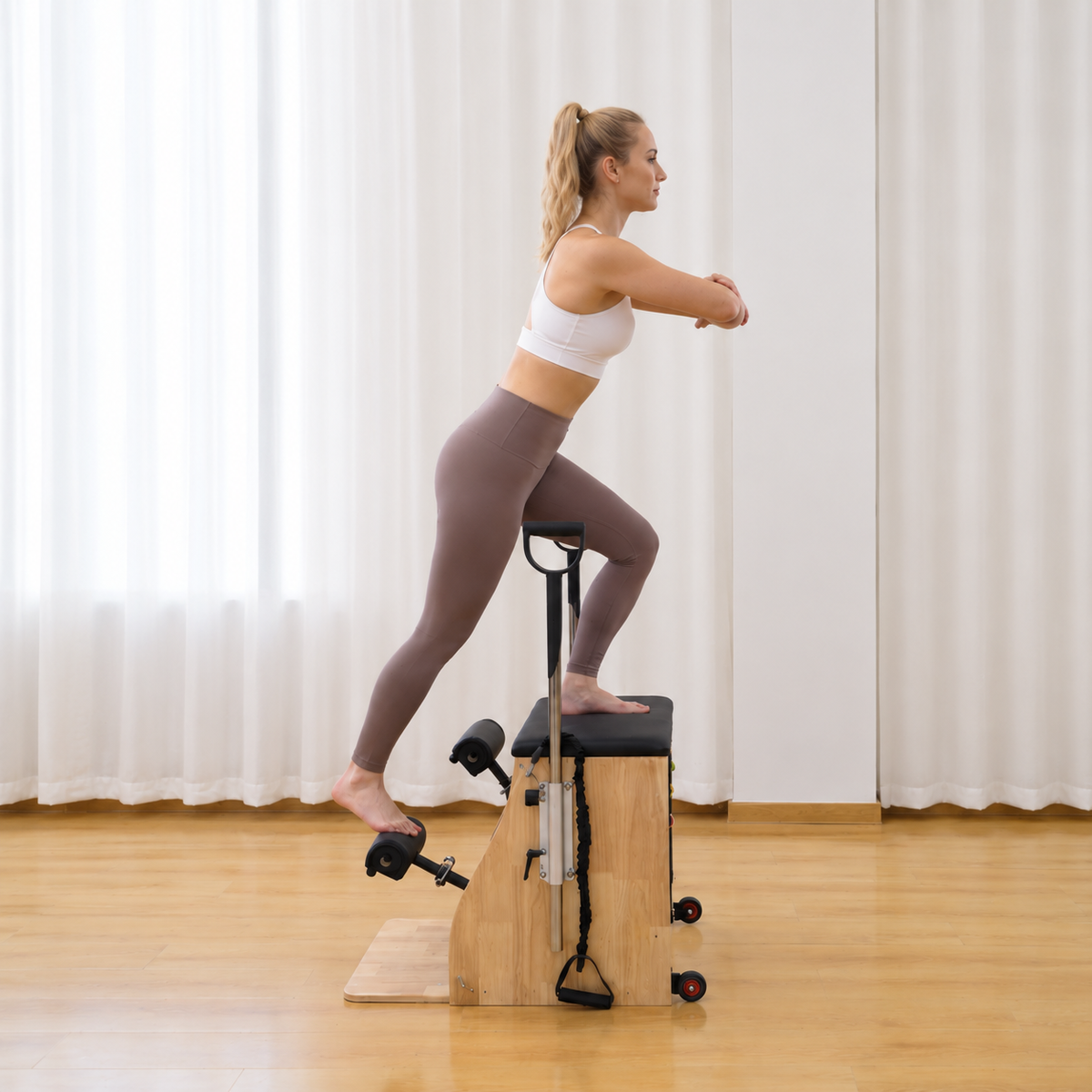
A Wunda chair can look deceptively simple: a compact seat, a pedal, springs, and plenty of possibility. The most meaningful Wunda chair benefits come from that simplicity. It gives you a focused way to build strength, improve control, and add variety to home Pilates without dedicating an entire room to a large piece of equipment.
For people who want studio-inspired movement on their own schedule, the chair offers a practical middle ground. It asks for more balance and body awareness than a reformer in many exercises, yet its small footprint makes it especially appealing for apartments, shared rooms, and wellness spaces that need to stay functional between workouts.
What Makes a Wunda Chair Different?
A Pilates Wunda chair uses spring resistance and a movable pedal to create exercises for the legs, arms, core, back, and hips. Unlike a reformer, which has a sliding carriage and longer frame, a chair keeps you close to a stable base. You may sit, stand, kneel, lie across it, or support part of your body weight on it.
That design changes the feeling of your workout. A reformer can provide a long, flowing range of motion and more support through the carriage. A chair often feels more concentrated. Small shifts in your ribs, hips, feet, or shoulders become easier to notice because you are working from a smaller surface and frequently managing your balance at the same time.
The BeReform Wooden Pilates Wunda Chair adds a split-pedal design that can be used as one connected surface or separated for unilateral exercises. It also provides four spring positions, two spring strengths, and removable handles with three height settings, allowing the setup to change for different movements and users.
This does not mean a chair is only for advanced Pilates users. Beginners can use it with supportive spring settings, straightforward seated movements, and careful positioning. It does mean that good form matters. Start slowly, follow clear instruction, and choose settings that let you move with control rather than momentum.
Wunda Chair Benefits for Everyday Strength
The chair is known for creating serious work from a compact setup. Its spring-loaded pedal can challenge the lower body in ways that feel familiar, such as presses and supported squats, while also offering more Pilates-specific patterns for stability and alignment.
Build Lower-Body Strength With Control
Pressing the pedal with one or both feet can train the glutes, thighs, calves, and muscles around the hips. Because the pedal moves against spring resistance, you have to control both directions: pressing down and returning it smoothly. That return phase is where many people notice how much attention their legs need.
Single-leg work can be particularly useful for recognizing left-to-right differences. Most bodies have a stronger or more coordinated side. Working each leg separately can help you develop more even control over time, provided the resistance and range feel appropriate for you.
A split pedal creates additional options for this kind of training. Each side can move independently for unilateral work or remain connected when you want a single, stable pedal surface. Begin with the connected setup until you understand how the springs and pedal respond.
Challenge Your Core Without Relying on Crunches
On a Wunda chair, your core is often working before an exercise looks like an abdominal exercise. When you sit tall and press the pedal, for example, your trunk helps keep your pelvis steady. When you stand beside or on the chair, your midsection helps you resist twisting or collapsing as your limbs move.
This is one reason the chair can make short workouts feel productive. Rather than isolating one area at a time, many movements ask your core, hips, shoulders, and breath to coordinate. The goal is not to brace as hard as possible. It is to create enough support to move smoothly and stay connected to your position.
Improve Balance and Body Awareness
Balance is not just about standing on one leg. It also involves sensing where your weight is, adjusting to small changes, and maintaining control when a moving pedal adds resistance beneath your hands or feet.
The chair can train these skills gradually. A seated press or supported standing movement may feel approachable, while upright single-leg variations require more focus and experience. Adjustable handles can provide a useful point of contact, but they should support control rather than replace it.
Over time, this kind of practice can make everyday movements—climbing stairs, carrying groceries, or getting up from the floor—feel more deliberate and coordinated.
Support Posture Through Stronger Movement Habits
No piece of equipment can fix posture by itself. Still, a Wunda chair can support the strength and awareness that contribute to a more comfortable upright position. Exercises for the upper back, shoulders, glutes, and deep abdominal muscles encourage you to organize your body instead of simply pushing through a repetition.
For desk workers, this can be a welcome complement to long periods of sitting. A few well-chosen movements may help you practice opening through the chest, stabilizing the shoulder blades, and using the hips more effectively. Think of it as movement practice, not a quick correction for years of habits.
A Compact Option for a Home Pilates Space
One of the most practical benefits of a Wunda chair is how little room it requires. A reformer is a worthwhile investment for full-body Pilates and long, varied workouts, but it needs more floor space even when designed to fold away. A chair can fit more naturally into a bedroom corner, home office, or living area.
The BeReform Wooden Pilates Wunda Chair has a body footprint of approximately 29.9 by 24.8 inches. Its removable handles adjust to three heights, reaching up to approximately 50 inches, so remember to include handle height and surrounding movement space when planning its location.
That smaller footprint can reduce the friction that gets in the way of consistency. If you can leave the chair accessible or move it into place in moments, a 15-minute strength session becomes more realistic on a busy morning or between meetings. You are less likely to skip movement because setup feels like a project.
Its design-conscious scale also works well for people who want their home to feel calm rather than crowded with fitness equipment. A quality wooden chair can offer a polished, studio-inspired presence without taking over the room.
Compact does not mean extremely light, however. A stable wooden chair is still a substantial piece of equipment. Plan where it will live before delivery, measure doorways and hallways, and ask for help when lifting or moving it if needed.
Who Will Get the Most From a Wunda Chair?
A Wunda chair is a strong fit for someone who enjoys Pilates but wants more strength and standing work in their routine. It can also serve people who already own a reformer and want a compact second apparatus for challenging, focused sessions.
It is especially helpful for home exercisers who value variety. The same chair can support seated leg presses, standing balance work, upper-body pressing, side-body exercises, unilateral training, and mobility-focused positions. That range makes it easier to avoid the feeling that every workout is the same.
For a complete beginner, the decision depends on comfort level and access to guidance. A chair can be approachable, but it is less forgiving than some larger equipment because the pedal is spring-loaded and the base is compact. Beginners who want maximum support while learning Pilates fundamentals may prefer beginning with a reformer, mat work, or guided sessions. Those who are ready to learn carefully can still make a chair a rewarding first apparatus.
If you have an injury, recent surgery, persistent pain, balance concerns, or are pregnant, check with a qualified healthcare professional and work with an experienced Pilates instructor when possible. The appropriate exercise, spring setting, and range of motion are highly individual.
How to Use a Wunda Chair Safely at Home
The chair rewards precision, not speed. Before each workout, make sure it is on a level, non-slip surface with clear room around it. Confirm that the springs are attached securely and that you understand the resistance setting before placing weight on the pedal.
If the chair has adjustable or removable handles, confirm that each handle is set to the same height and fully locked before using it for support. If you are using a split pedal, check whether the locking slider is engaged or released for the exercise you intend to perform.
Start with the pedal under control. Depending on the exercise and spring setup, it may rise quickly if released, so keep a steady hand or foot on it until you are fully positioned. Move slowly enough to notice whether your shoulders are creeping up, your back is arching excessively, or your weight is shifting into one side.
Choose a supportive spring setting when learning an exercise, but remember that lighter resistance is not always easier. A lighter spring may provide less support and demand more balance or control. The best setting is one that lets you complete each repetition with a smooth return and stable alignment.
Begin with seated or well-supported exercises before attempting standing or single-leg movements. Grip socks may improve traction, but they do not replace correct positioning, controlled transitions, or qualified instruction.
It also helps to build a repeatable routine rather than chasing a new advanced move every day. Two or three familiar exercises, practiced well, can do more for confidence than a long session spent guessing. BeReform home Pilates equipment is designed to make that kind of consistent, space-conscious practice feel more achievable.
Is a Wunda Chair Worth Adding to Your Routine?
A Wunda chair is worth considering if you want a compact way to make Pilates feel more strength-focused, dynamic, and engaging at home. It does not replace every benefit of a reformer, and it will not suit everyone as their only piece of equipment. The trade-off for its small size is that it can feel more technically demanding, particularly in standing exercises.
Still, that challenge is part of its appeal. With thoughtful setup and steady practice, the chair can meet you where you are: a quick lower-body session before work, a posture-focused reset after a long day, or a more complete Pilates workout when you have time.
Give yourself permission to begin with the basics, move with care, and let consistency build the strength you came for.
Frequently Asked Questions
Is a Wunda chair suitable for beginners?
Yes, but beginners should start with seated or supported exercises and clear instruction. A Wunda chair has a moving spring-loaded pedal and a smaller base than a reformer, so some exercises require more balance and control. Learn the spring settings and basic transitions before attempting standing or single-leg movements.
What is the difference between a Wunda chair and a reformer?
A reformer uses a long frame, moving carriage, springs, and straps to provide supported, flowing movement over a larger range. A Wunda chair uses a compact seat and spring-loaded pedal, creating more concentrated strength and balance challenges. A reformer generally offers more support and exercise variety, while a chair requires less floor space and works particularly well for focused strength sessions.
Does a lighter spring make Wunda chair exercises easier?
Not always. Heavier springs may make the pedal harder to press but can provide more support as it returns. Lighter springs reduce pressing resistance but may require greater balance and control. The right setting depends on the exercise, your position, and your experience level.
How much room do I need for a Wunda chair?
Measure the chair’s footprint, full handle height, and the open area needed to move around it. The BeReform Wooden Pilates Wunda Chair measures approximately 29.9 by 24.8 inches at its base, with adjustable handles reaching up to about 50 inches. Leave additional clearance for stepping on and off, extending your limbs, and performing standing exercises safely.
Can a Wunda chair replace a Pilates reformer?
It can serve as the primary Pilates apparatus for someone who values compact strength and balance training, but it does not reproduce every reformer movement. A reformer provides a sliding carriage, straps, and more support for long-range exercises. Many experienced users treat the chair as a complement to mat or reformer Pilates rather than a direct replacement.