
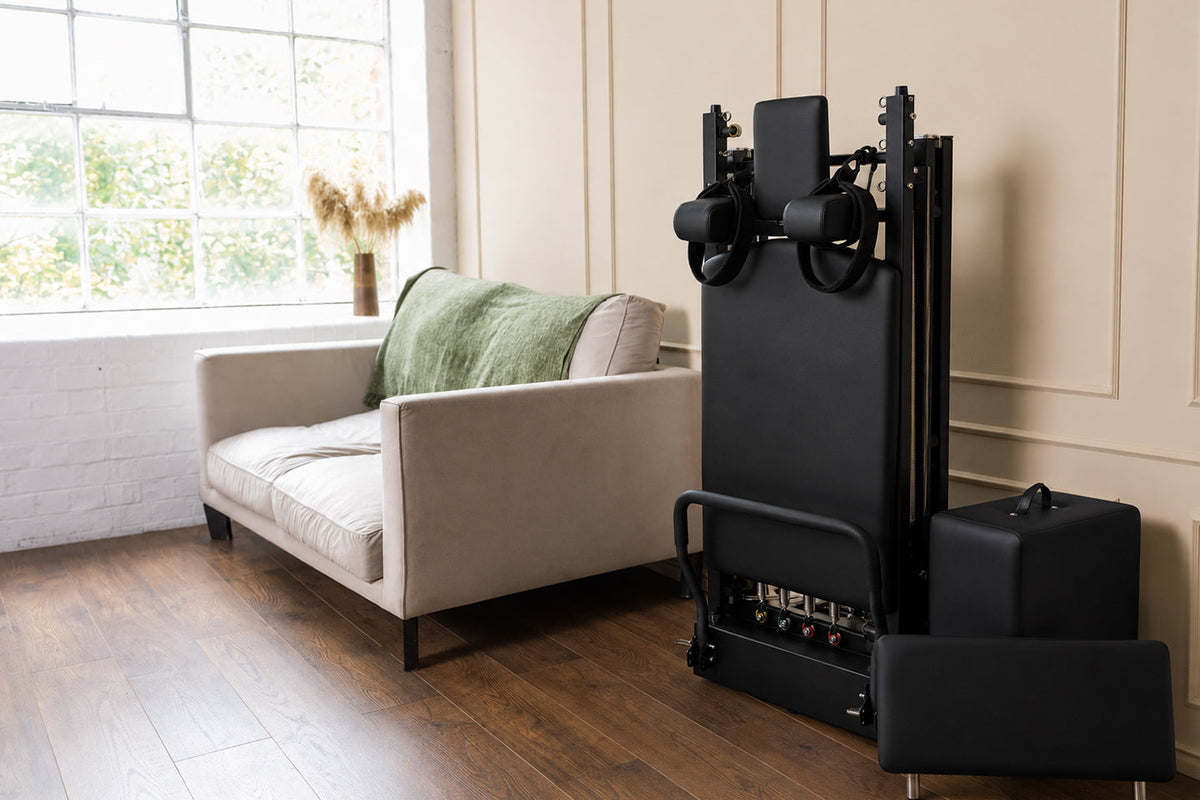
A reformer can make home workouts feel more intentional, but a full-size studio machine is not an easy fit for every living room, bedroom, or spare office. This folding reformer review looks at the question that matters most for real life: does a reformer that folds away still feel good enough to use consistently?
For many households, the answer is yes, provided the machine has a stable frame, smooth carriage travel, practical resistance options, and a folding design you will actually use. The best choice is not necessarily the reformer with the longest feature list. It is the one that fits your space, your body, and the routine you want to keep.
Why a Folding Reformer Makes Sense at Home
A traditional reformer earns its footprint in a busy studio, where it is used all day and never needs to move. At home, that same footprint can become a barrier. If your machine takes over a room, getting started may feel like a project rather than a simple 30-minute reset between meetings or after the kids are asleep.
A folding reformer changes that equation. When stored upright or folded compactly after use, it can free up valuable floor space without asking you to compromise on the core reformer experience: guided carriage movement, spring-based resistance, footwork, core work, mobility, and full-body strength training.
That convenience is especially meaningful for apartment dwellers, multipurpose homes, and anyone who wants their wellness routine to support a calm living space rather than compete with it. Folding is not just a storage feature. It removes friction from the habit.
Folding Reformer Review: What to Look for First
Not all foldable models feel alike. A lower price can be appealing, but a folding mechanism alone does not tell you whether the reformer will feel steady, comfortable, or suitable for regular workouts.
Frame Stability and Weight Capacity
The first thing to assess is the frame. When unfolded and locked into position, a quality folding reformer should feel planted under you. There should be no distracting shifting as you press through your feet, kneel on the carriage, or change positions.
Steel frames often offer a clean, modern look and dependable support. Wooden reformers can bring a warmer, more furniture-like presence to a home. Neither material is automatically better. What matters is thoughtful construction, secure locking points, and a weight capacity that suits the people who will use it.
If more than one person in your household plans to train, choose with the heaviest intended user in mind rather than assuming a compact machine is only for smaller bodies. A higher capacity may also provide a more substantial feel, but the published number should always be considered alongside frame stability, carriage dimensions, and overall construction.
Within the BeReform range, the CORE Steel Foldable Reformer supports up to 220 pounds and offers a lighter frame for smaller home spaces. The wooden FLOW and PRIME models support up to 551 pounds and provide a more substantial full-size setup.
Carriage Movement and Everyday Comfort
A reformer should encourage you to move, not make every exercise feel noisy or awkward. Smooth carriage travel matters because it helps your workout feel controlled, especially during slower Pilates sequences where alignment and pace are part of the challenge.
Pay attention to carriage padding, shoulder rests, and the footbar. These are the contact points you will notice in every session. Supportive padding and adjustable elements can make the machine feel welcoming for beginners while giving experienced users more options for footwork, lunges, planks, and mobility work.
Quiet operation is also worth prioritizing. A little mechanical sound is normal, but excessive rattling, squeaking, or knocking can make it harder to exercise early in the morning or while someone else is working nearby. A smooth, quieter carriage is often one of the clearest signs that a home reformer is designed for repeat use instead of occasional novelty.
Resistance That Can Grow With You
Springs create the signature resistance of reformer Pilates. A practical home machine should offer enough range to keep your routine useful as you gain confidence and strength. Lighter resistance helps with controlled mobility, coordination, and learning unfamiliar exercises. More resistance opens the door to stronger lower-body work, challenging rows, and dynamic full-body sequences.
More springs are not automatically better, though. What counts is a combination that feels manageable to change and gives you distinct levels of challenge. Look for clear spring settings and secure attachment points. If adjusting resistance feels confusing, you may stay with the same setup every time and miss much of the reformer’s versatility.
CORE uses a five-spring system, while FLOW and PRIME use six-spring systems with a broader selection of resistance levels. Regardless of the number of springs, the most useful system is the one you can understand and adjust confidently for different movements.
The Folding Process Itself
This is where a folding reformer either proves its value or becomes an underused piece of equipment. Ask a simple question: could you comfortably fold, move, and store it after a workout on a normal Tuesday?
Hydraulic-assisted folding can make storage easier by reducing the lifting effort. Manual folding may be perfectly suitable when the mechanism is straightforward and you are comfortable managing the movement. In either case, the process should be clear, controlled, and secure. Wheels are helpful for repositioning the folded unit, but they do not replace a manageable folding system.
BeReform offers different approaches depending on how often you expect to store the machine. CORE has a lighter steel frame and built-in wheels for compact home storage. FLOW combines a full-size wooden frame with manual folding, while PRIME adds hydraulic assistance for users who expect to open and fold their reformer frequently.
Before buying, measure the open workout area and the storage area. Include room to walk around the machine, not just the reformer’s listed dimensions. Also measure the folding path, doorway widths, hallway turns, and the route from the delivery entrance to the final room.
Where Folding Reformers Make Trade-Offs
A well-designed foldable reformer can be an excellent long-term home investment, but it is not identical to a heavy commercial machine. Folding designs have more moving parts and may have a slightly different feel than a permanently assembled studio reformer. For most at-home users, that is a reasonable exchange for the ability to reclaim the room after training.
The trade-off becomes less appealing if you want a reformer that remains set up permanently, use advanced studio accessories every day, or expect multiple hours of intensive use from several people. In those cases, a larger non-folding commercial setup may be a better fit.
Folding also introduces an additional maintenance point. Hinges, locks, wheels, and assisted mechanisms should be inspected as directed by the manufacturer. Before every workout, make sure the reformer is fully opened and securely locked. Never exercise while the frame is partially folded or a locking point is not properly engaged.
For many home users, portability and a smaller storage profile are the features that make the equipment more valuable. A premium machine that never fits your life is less useful than a thoughtfully designed folding one that invites you to use it four times a week.
Who Gets the Most Value From One?
A folding reformer works particularly well for people who enjoy the structure of studio Pilates but want more control over time and cost. It can also be a natural option for beginners who prefer to build confidence at home with clear, instructor-led guidance.
Busy professionals may use it for a quick lunchtime mobility session. Parents may appreciate being able to store it away between workouts. Former studio members can recreate familiar movement patterns without scheduling around a class calendar. For couples or families, an adjustable reformer can serve several fitness goals, from low-impact strength to mobility, posture awareness, and everyday flexibility.
The key is to be honest about your habits. If you enjoy guided workouts and want equipment that supports variety, a reformer can be a refreshing alternative to repeating the same mat routine. If you prefer simple, equipment-free exercise and do not expect to use spring resistance often, a reformer may be more investment than you need.
How to Judge Value Beyond the Sale Price
The cost of a folding reformer should be considered over years of use, not only at checkout. Compare the purchase with the ongoing expense of studio classes, but also look closely at what protects the investment. Warranty coverage, safety information, shipping process, return terms, replacement-part availability, and customer support all matter when you are purchasing a larger piece of home equipment online.
It also helps to separate useful features from decorative extras. The features with the greatest daily impact are usually a stable frame, easy storage, smooth carriage movement, adjustable resistance, comfortable contact points, and clear setup instructions. A polished finish is a welcome part of a home-friendly design, but it should support the experience rather than distract from build quality.
BeReform focuses its folding reformers around this balance: studio-inspired movement in formats designed for residential spaces. CORE provides a lighter, narrower starting option, FLOW offers a full-size wooden frame with manual folding, and PRIME adds hydraulic assistance and greater adjustability. The goal is not to turn your home into a commercial gym, but to create a reliable place to move with ease.
A Better Test Than “Will I Use It?”
Instead of asking whether you will use a folding reformer every day, imagine three specific moments: a 20-minute morning session, a longer weekend workout, and the task of putting it away afterward. If all three feel realistic in your home, you are looking at equipment that can support a lasting routine.
The right folding reformer should not demand a dedicated fitness room or a perfect schedule. It should make it easier to choose movement on the days when time, space, and energy are limited.
Frequently Asked Questions
Is a folding Pilates reformer worth buying for home use?
A folding reformer can be worthwhile if limited space is one of the main barriers to exercising at home. It provides the carriage movement and spring resistance of reformer Pilates while allowing you to reclaim the room afterward. Its value depends on build quality, ease of folding, available storage, and how consistently you expect to use it.
Are folding reformers as stable as fixed reformers?
A well-built folding reformer can feel stable during regular home workouts when it is fully opened, correctly assembled, and securely locked. Stability depends on the frame construction, base footprint, locking mechanism, weight capacity, and floor surface. A folding model should not be used if the frame shifts, a lock does not engage, or the mechanism appears damaged.
Is hydraulic-assisted folding better than manual folding?
Hydraulic assistance can make a heavier reformer easier to open and store, particularly if you fold it after most sessions. Manual folding may be enough for someone who stores the machine less frequently or is comfortable managing the process. The best option depends on the reformer’s weight, your physical comfort, and how often the room needs to be cleared.
How much room do I need for a folding reformer?
Measure the reformer at full workout length, in its folded position, and throughout the folding path. You also need clearance along the sides and ends for mounting, adjusting springs, using straps, and moving safely. Check doorway widths, hallways, stairs, elevators, and ceiling height before ordering.
Which BeReform folding reformer should I choose?
Choose the CORE if you want a lighter steel-frame model for a smaller space or a first home reformer. Choose the FLOW if you want a full-size wooden frame for regular workouts and are comfortable with manual folding. Choose the PRIME if you want hydraulic-assisted folding, greater adjustability, and a setup designed for more advanced home practice.