
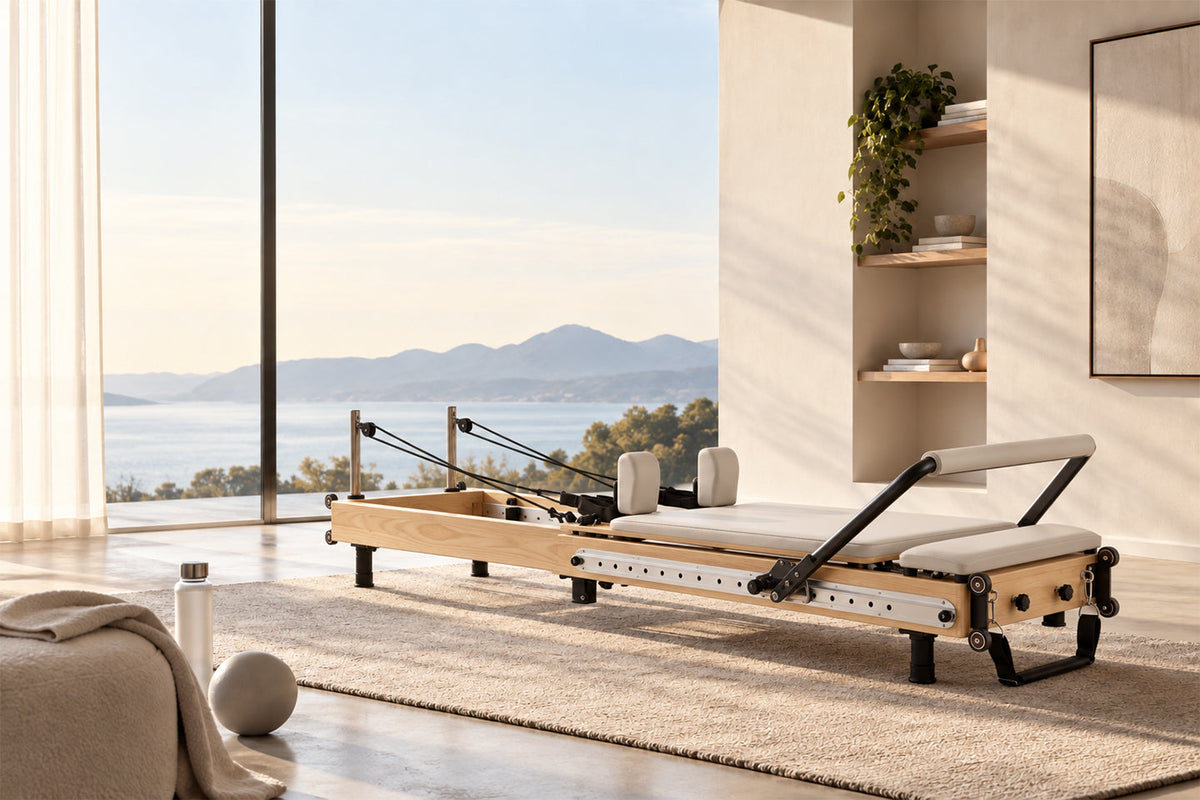
A reformer can look compact in a product photo and still take over a room once it arrives. That is why Pilates reformer dimensions deserve as much attention as springs, straps, and styling. The right fit lets you move comfortably, fold or store the equipment without a daily struggle, and keep your home feeling like home.
For most at-home buyers, the question is not simply, “Will it fit?” It is, “Will I actually want to use it here several times a week?” A well-planned setup creates the calm, convenient routine that makes home Pilates worth the investment.
Standard Pilates Reformer Dimensions
A full-length home Pilates reformer is commonly around 80 to 100 inches long and 20 to 32 inches wide. Height varies more significantly by model. Some home reformers sit close to the floor, while elevated studio-inspired models may place the carriage roughly 14 to 18 inches high. These figures are a starting point, not a substitute for checking the listed specifications of the exact reformer you are considering.
Length matters because the carriage needs room to travel and the frame extends beyond the place where you sit or lie down. Taller users may also prefer a longer carriage track, particularly if they want a more natural range of motion during footwork, lunges, and full-body Pilates sessions.
Width affects both your movement and the visual footprint of the machine. A narrower reformer can be a smart choice in an apartment or multipurpose room, while a wider, more substantial frame may feel more stable and studio-inspired. Neither is automatically better. The best choice is the one that matches your available space, body size, and training goals.
Within BeReform’s home range, the CORE Steel Foldable Reformer offers a narrower 21-inch-wide frame, while the wooden FLOW and PRIME models are 31.5 inches wide for a more substantial setup.
The Space Around a Reformer Matters Too
The reformer’s frame dimensions are only part of the equation. You need room to get onto the carriage, adjust springs, use straps, and move around the side of the machine without bumping into a wall, bed, or desk.
As a practical guideline, plan for at least 12 to 24 inches of open space along each side when possible. Leave extra clearance at the footbar end and behind the headrest, especially if you enjoy exercises that require stepping on and off the carriage. A room that is about 8 by 10 feet can often work for a reformer, but the layout matters more than the room label.
If your space is tight, avoid placing the reformer so close to a wall that spring changes become awkward. Small moments of friction add up. When setup feels inconvenient, it is easier to postpone a workout. A little breathing room helps the equipment feel like an invitation rather than another thing to navigate around.
Measure the Real Path, Not Just the Open Floor
Before ordering, measure the room where you plan to exercise, then measure the route into it. Hallways, stair landings, apartment elevators, doorways, and sharp turns can be more limiting than the workout area itself.
Use painter’s tape on the floor to mark the reformer’s full footprint. Then stand beside the outline, walk around it, and picture using the carriage. This simple test makes it easier to spot conflicts with closet doors, drawers, radiators, or furniture that needs to remain accessible.
Also consider ceiling height if you plan to perform standing movements, use a jumpboard, position a screen nearby for guided workouts, or keep other Pilates equipment in the same area. Most standard rooms are suitable for reformer workouts, but a low ceiling can influence how freely you use the space.
Do not forget the delivery packaging. A reformer may fit comfortably in the final room while its cartons are too large or heavy to navigate through a narrow staircase or sharp hallway corner. Check package dimensions and delivery requirements separately from the assembled equipment dimensions.
Folded Pilates Reformer Dimensions
A foldable reformer changes the storage conversation. Rather than dedicating a room to fitness equipment, you can create a studio-inspired Pilates corner when you are ready to move, then reclaim the floor afterward.
Folded Pilates reformer dimensions vary significantly. Some models fold flat enough to fit into a suitable storage area, while others become shorter and more compact but still need a dedicated wall or storage nook. Hydraulic-assisted folding systems can make this process more manageable for people who want to set up and put away their equipment regularly. Manual-fold options may suit users who do not mind handling more of the folding movement themselves.
For reference, the current BeReform model dimensions are listed below in length × width × height:
- The CORE Steel Foldable Reformer measures 96 × 21 × 6.1 inches when open and 53 × 21 × 13 inches when folded.
- The FLOW Wooden Foldable Reformer measures 94 × 31.5 × 9inches when open and 48 × 31.5 × 14 inches when folded.
- The PRIME Adjustable Wooden Reformer measures 94 × 31.5 × 9-11 inches when open and 48 × 31.5 × 14 inches when folded.
FLOW uses a manual folding system, while PRIME includes hydraulic assistance for users who expect to open and store the reformer frequently. CORE offers a lighter and narrower steel-frame option for compact workout areas.
Do not focus only on folded length. Check the folded height, depth, total equipment weight, wheel placement, and whether the reformer is designed to stand upright safely. A slim folded profile is valuable, but it is only useful if you can move and store the unit comfortably in your own home.
For a bedroom, home office, or living room, think about where the reformer will rest between sessions. A clear wall, spacious closet, or dedicated corner can work well, depending on the model. The most successful storage plan is usually the simplest one: a spot that requires minimal lifting, rearranging, or decision-making.
Choose Dimensions Based on How You Will Use It
Your body, routine, and household should guide the decision. Beginners often benefit from a straightforward, approachable model with an easy setup and enough carriage length to feel supported while learning. Experienced Pilates users may prioritize a longer frame, more adjustability, and a carriage feel that supports varied programming.
If more than one person will use the reformer, look closely at user-height recommendations, carriage travel, adjustable footbars, rail length, and rope settings. A reformer that feels ideal for one person may feel restrictive for a taller partner or family member. Shared equipment should offer enough adaptability to keep everyone comfortable.
Your preferred workout style matters as well. If your routine centers on controlled Pilates fundamentals, a compact footprint may be plenty. If you want to combine Pilates with mobility, strength work, standing exercises, or longer sessions at home, give yourself a little more clearance and choose a setup that is easy to access every day.
A foldable model is not automatically the right answer for every buyer. If you have a dedicated workout room and use your reformer often, a non-folding design can be wonderfully convenient because it is always ready. But for a multipurpose home, a folding reformer can make consistent movement more realistic without permanently sacrificing your living space.
A Simple Measurement Checklist Before You Buy
Take these measurements before narrowing down your options:
- The open floor area, including clearance around the sides and ends of the reformer.
- The storage area, measured for the reformer’s folded length, width, height, and depth.
- The full folding path needed to move safely between the open and stored positions.
- Every doorway, hallway, elevator, and stair turn between delivery access and the final room.
- The distance to nearby furniture, outlets, windows, radiators, and doors that must stay usable.
- The dimensions and weight of the delivery cartons, particularly if the room is upstairs or reached through a narrow entrance.
Write the numbers down rather than relying on memory. Compare them with both the assembled and folded specifications, plus any recommended user-height range and weight capacity. This is one purchase where a tape measure can prevent a great deal of second-guessing.
Small-Space Setup Ideas That Feel Intentional
A reformer does not need a formal home gym to look considered. In a living room, choose a wall where the folded unit can sit neatly without blocking natural traffic flow. In a bedroom, place it where morning light and a clear patch of floor make a quick session feel appealing. In a home office, create a transition between work and movement by storing the reformer out of the way once your session ends.
A mat, small basket for accessories, and clear floor space are often enough to make the area feel complete. You do not need to fill the room with equipment. The goal is a setup that supports regular use and preserves the relaxed feel of your space.
BeReform designs home-friendly reformer options around this balance: studio-inspired movement, manageable storage, and dimensions suited to real residential rooms. CORE offers a narrower footprint, while FLOW and PRIME provide a wider wooden frame for users who have more workout space but still want the option to fold the equipment afterward.
The best reformer is not necessarily the largest one or the one that folds the smallest. It is the one that gives your body room to move and gives your routine a place to stay. Measure carefully, picture the full experience from delivery and setup through storage, and choose the dimensions that make Pilates feel easy to return to tomorrow.
Frequently Asked Questions
What are the average dimensions of a home Pilates reformer?
Many full-length home reformers measure approximately 80 to 100 inches long and 20 to 32 inches wide. Height varies considerably between low-profile home machines and elevated studio-style models. Always use the specifications for the exact model rather than relying only on an average range.
How much room should I leave around a Pilates reformer?
When possible, leave approximately 12 to 24 inches along each side, with additional space at the headrest and footbar ends. You need enough clearance to get on and off safely, adjust springs, use straps, extend your limbs, and walk around the machine without hitting furniture or walls.
Should I compare open or folded reformer dimensions?
Compare both. Open dimensions determine whether you can exercise comfortably, while folded dimensions determine whether the reformer can be stored without blocking daily life. You should also measure the folding path because the machine needs space to transition safely between the two positions.
What dimensions should taller users look for?
Taller users should consider overall frame length, carriage travel, rope length, footbar positions, and the manufacturer’s recommended user-height range. Overall length alone does not show how much usable movement space the reformer provides. Adjustable rails and ropes can make a meaningful difference for shared households and taller users.
Which BeReform model is best for a small space?
The CORE Steel Foldable Reformer has the narrowest footprint at 21 inches wide, making it the most compact option among these three models. FLOW and PRIME are both 31.5 inches wide and suit buyers who want a more substantial wooden frame. PRIME may be more convenient when frequent storage is important because it includes hydraulic-assisted folding.