
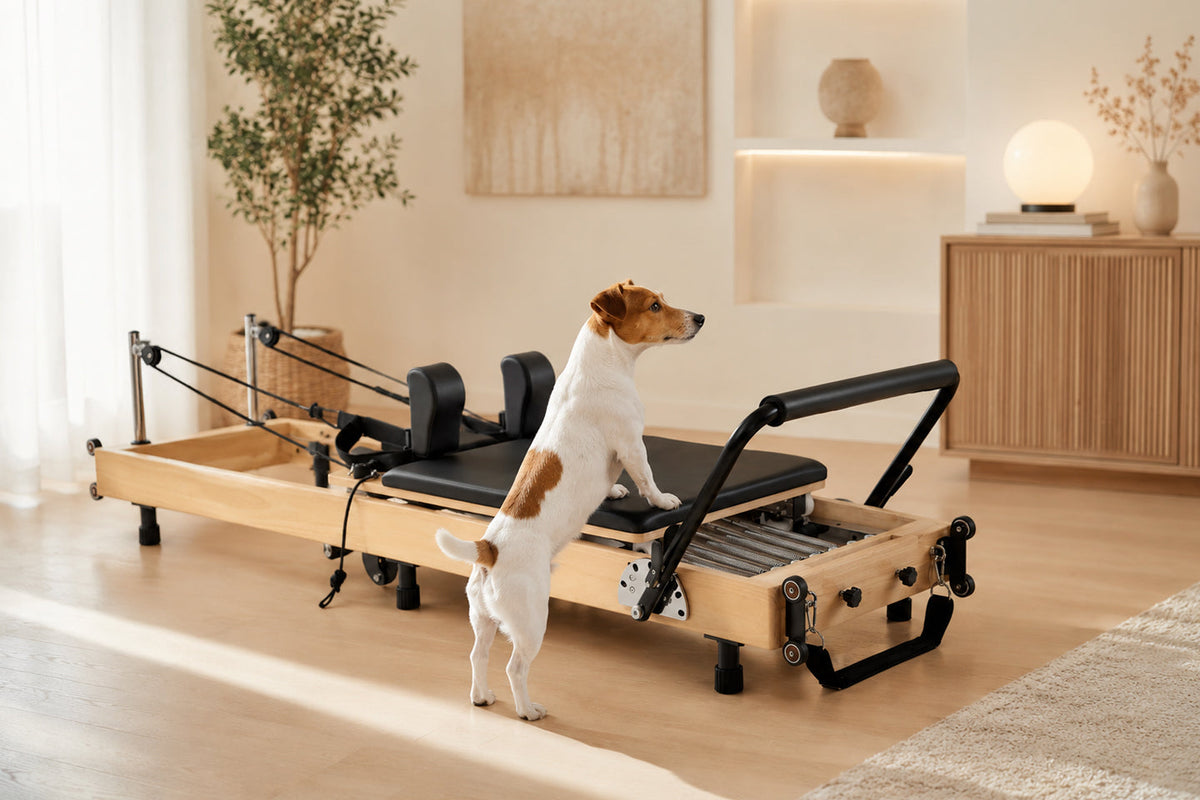
A reformer should make it easier to focus on your movement, not make you second-guess the equipment beneath you. The best reformer safety features support that confidence in quiet, practical ways: a steady frame, predictable spring tension, a carriage that moves smoothly, and a folding system that feels controlled instead of awkward.
For home Pilates, safety is also about daily fit. A reformer that is simple to set up, stable on your floor, and designed for regular use removes friction from your routine. Whether you are choosing your first reformer or replacing a basic model, here is what deserves your attention before you bring one home.
Start With a Frame That Stays Put
A reformer’s frame is its foundation. During footwork, lunges, planks, and side-lying work, you need the machine to feel planted rather than light or unstable. Look for a solid wood or steel frame with a wide, balanced footprint and quality construction at the joints.
Material alone does not tell the full story. A well-designed wooden reformer can feel exceptionally grounded and add warmth to a wellness space, while a steel frame may suit someone who wants a more streamlined, contemporary look. What matters most is that the frame is built to handle its stated weight capacity and the changing pressure of real movement.
BeReform offers both approaches. The CORE Steel Foldable Reformer uses a lightweight steel frame for easier movement and compact storage, while the FLOW Wooden Foldable Reformer and PRIME Adjustable Wooden Reformer use solid oak frames for a more substantial, studio-inspired feel.
Floor contact matters, too. Non-slip feet or floor-friendly pads help prevent the reformer from shifting while also protecting hard floors. If your exercise area has a smooth surface such as tile, hardwood, or laminate, this small feature becomes especially meaningful. If plush carpet prevents all feet from contacting the floor evenly, use a firmer, level location rather than relying on a soft exercise mat to correct the instability.
A level setup is part of the safety system
Even a well-made reformer cannot perform as intended on an uneven surface. Before your first workout, place it on a clear, level area with enough room to move around the sides and ends. Check that all feet contact the floor evenly and that no furniture, wall edge, or rug corner interferes with the carriage path.
Secure Springs Matter More Than Spring Count
Springs create resistance, support, and control. They are also the feature that deserves the most consistent visual check. A safe reformer uses springs that attach securely at both ends, with clear anchor points and hardware designed to stay in place through repeated use.
The ideal number of springs depends on the reformer and the kind of training you plan to do. More options can give experienced users greater range, while a straightforward configuration may feel less overwhelming for beginners. In either case, easy-to-identify resistance levels are helpful. When you can quickly see which springs are attached, you are less likely to start an exercise with more or less tension than intended.
For example, the BeReform CORE uses five commercial-grade springs with five spring points. The FLOW and PRIME use six springs across different resistance levels, providing more combinations for lower-body, upper-body, and full-body exercises. Always follow the spring guidance for the exact model you own rather than assuming that colors or resistance levels are identical across brands.
Before each session, glance at the springs for gaps, distortion, corrosion, or loose clips. Never use a spring that appears damaged. Springs are wearable components, so follow the manufacturer’s care guidance and replace them when recommended. This is not a detail to postpone, particularly in a household where several people use the equipment.
Change resistance with the carriage at rest
When adjusting springs, bring the carriage fully home first and make changes with control. Avoid reaching over a moving carriage or changing resistance while someone is positioned on the machine. It takes only a moment, and it helps keep the setup calm and predictable.
Smooth Carriage Movement Helps You Stay in Control
A carriage should glide with steady resistance, not jerk, stick, or rattle. Smooth movement is often viewed as a comfort feature, but it is also a safety feature. It helps you maintain alignment and respond to the exercise rather than compensating for unpredictable motion.
Pay attention to how the carriage feels at both slow and faster tempos. It should travel evenly along its track and return to the stopper without an aggressive impact. Quality wheels, secure track construction, and regular cleaning all contribute to that experience.
Keep the rails clear of dust, pet hair, and small household debris. A quick wipe-down can prevent buildup that affects the ride of the carriage. If you notice new noise, uneven tracking, or resistance that feels unusual, pause your workout and inspect the machine before continuing.
A Reliable Stopper and Adjustable Footbar Build Confidence
The stopper sets the resting position of the carriage. It may not be the flashiest part of a reformer, but it helps establish a safe starting point for many exercises. A secure, adjustable stopper gives users of different heights a better chance of finding a position that supports comfortable knee and hip alignment.
The footbar deserves the same attention. It should lock firmly into each available setting without wobble. An adjustable footbar can make a meaningful difference for a shared household, since a comfortable starting position for a taller partner may not work for someone shorter.
Before placing weight through the footbar, confirm it is fully engaged. This habit is especially useful when transitioning between exercises or when using a reformer after another household member has adjusted it. Never assume the previous setting is the right one for you.
The Best Folding Reformer Safety Features Help Reduce Pinch Risks
A foldable reformer can be a smart choice for apartments, multipurpose rooms, and homes where wellness equipment needs to disappear between sessions. But folding should never feel like a balancing act. Useful safety features for compact living include secure locking points, controlled hinges, clear folding steps, and a design that stays stable in both open and stored positions.
A hydraulic assist can make lifting and lowering easier, particularly for people who do not want to wrestle with a heavy frame after a workout. The BeReform PRIME uses hydraulic-assisted folding, while the FLOW has a straightforward manual-folding system. The lighter steel CORE provides another compact option for users who prioritize easier movement and storage.
Manual folding can work well when the mechanism is straightforward and the reformer has a manageable weight. The trade-off is simple: a more compact design may require a few extra setup steps, while a larger fixed frame can offer maximum convenience if you have a dedicated Pilates room.
Always remove accessories and make sure the carriage is secured before folding. Keep children and pets clear of the area, use both hands where instructed, and do not rush the process. Once stored, confirm that the reformer is locked or positioned securely so it cannot roll, tip, or open unexpectedly.
Thoughtful Details Make Everyday Use Safer
Safety is rarely one dramatic feature. It is the combined effect of many well-considered details. A padded, non-slip carriage surface provides traction when hands, knees, or feet are supporting body weight. A headrest that adjusts securely can make supine work more comfortable, while shoulder rests that stay firmly in place give you a dependable reference point during footwork and bridging.
Straps and ropes should feel durable and move cleanly through their pulleys. Check them for fraying, stretching, or uneven wear, and make sure handles are attached securely before each use. If your reformer includes a jumpboard or box, use only accessories made for that model and install them according to the instructions.
Weight capacity is another essential specification. Choose a reformer rated appropriately for the heaviest intended user and stay within the manufacturer’s stated limit. A higher capacity can be reassuring for households with multiple users, but it does not replace proper form, regular inspections, or following the equipment’s guidelines.
Safe Use Starts Before Your First Class
The most polished reformer still needs an attentive setup. Read the assembly and care instructions, tighten hardware as directed, and take a few minutes to learn every adjustment before attempting a full workout. If you are new to Pilates, begin with foundational routines that teach spring changes, carriage control, and safe transitions.
It is also wise to give your reformer breathing room. Leave space behind the machine for the carriage, space beside it for mounting and dismounting, and a clear path for folding if applicable. Avoid socks that slide on the carriage or floor. Grip socks can be a helpful option, especially during standing or balance-focused work.
BeReform designs home-friendly reformers around the idea that a consistent routine should feel achievable, not complicated. Choosing a reformer with dependable safety features gives you more than peace of mind. It gives you a calmer place to move, strengthen, and return to yourself whenever your schedule allows.
Frequently Asked Questions
What are the most important safety features on a home Pilates reformer?
Prioritize a stable frame, secure spring attachments, smooth carriage movement, a firmly locking footbar, dependable straps and ropes, and a clearly stated weight capacity. For a folding model, also look for secure locking points and a controlled folding mechanism.
Are foldable Pilates reformers safe for home use?
A foldable reformer can be suitable for home use when it is fully opened, correctly locked, placed on a level surface, and used within its stated weight capacity. Always follow the model-specific folding instructions and check the locks before beginning a workout.
How much space should I leave around a Pilates reformer?
Leave enough space behind the carriage for its full travel and enough room along both sides to get on and off safely. You should also keep the area around the footbar clear. If the reformer folds, include the complete folding and storage path in your measurements.
How often should I inspect my home reformer?
Perform a quick visual check before each session. Confirm that the springs, clips, ropes, straps, footbar, shoulder rests, carriage, and folding locks are secure. Follow the manufacturer’s maintenance schedule for deeper inspections and stop using the reformer if you notice damage, loose hardware, unusual noise, or uneven movement.
Which BeReform model is suitable for my home setup?
The CORE is designed for beginners and smaller spaces, with a lightweight steel frame and compact folding design. The FLOW suits most home users who want a stable wooden frame and manual folding. The PRIME is designed for more advanced users who want greater adjustability and hydraulic-assisted folding.